Feature
One profession, many frameworks: reflections on our first seminar
The recording and slides from the Society’s first seminar, Comparing natural capital accounting frameworks: what does the profession need to understand?, are now on our website.
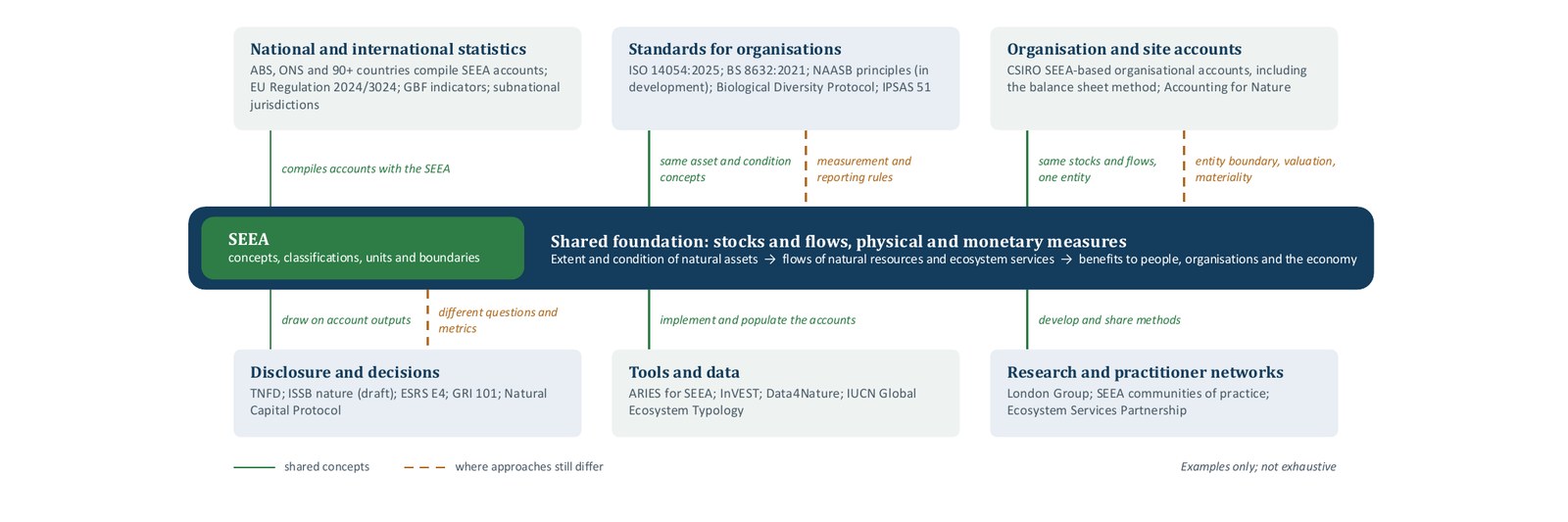
Nearly 100 people registered. The seminar was built around two questions. How do the natural capital accounting (NCA) frameworks used in the private sector compare with each other and with the System of Environmental-Economic Accounting (SEEA)? What would it take to make them comparable, and where can corporate practice and the SEEA learn from each other?
What we heard
John Finisdore and Joël Houdet drew on their earlier work with colleagues, including a review of four corporate case studies against criteria they developed. The case studies differed in how ecosystem assets were defined (land use classes in some, ecosystem types in others), whether condition was measured against a reference state, how gains and losses in condition were tracked, and where the assessment boundary was drawn. They found that these differences make it hard to compare NCA reports across organisations.
The definition and recording of liabilities is also not settled. One approach treats the gap between current and reference condition as a liability. Another limits a liability to being a legal or constructive obligation, such as a public commitment to be nature positive. Nonetheless, both approaches depend on attributing change to its cause, for example, the company’s actions or a wildfire. Carl Obst noted that the national accounts and SEEA communities are working through the same question in their discussion of distinguishing between depletion, degradation and other changes in volume.
Carter Ingram pointed to the benefits of spatially explicit SEEA accounts in providing a shared information base for companies operating in the same landscape, but possibly at different scales. Several businesses drawing on one catchment for water, or exposed to the same wildfire risk, would benefit from working from the same accounts.
Greg Smith and Tony O’Grady of CSIRO, whose work was among the studies John and Joël compared, also joined the discussion. Greg explained that CSIRO frames corporate accounts around the International Accounting Standards Board’s concept of control, which sets the boundary of the accounts. It proposes an ecosystem change statement to attribute changes in natural capital to their causes, so that change caused by a company’s own activities could create a liability to restore. Carl noted that much of what is called corporate NCA is in fact impact accounting. Tony reminded us that most companies do not directly control natural capital assets, and that existing examples are mostly about disclosure. What we lack are examples of information being used for internal management decisions. Until these emerge, many businesses will see NCA as a compliance cost rather than a source of information for decisions.
One profession
A key question for the Society is how to move the profession forward when entry points to NCA vary so widely. As John outlined, NCA has many definitions and interpretations. Carl suggested that accounting is, in the first instance, the organisation of information. If the information is organised consistently, it can then be analysed and presented in different ways for different purposes. That may be for a company’s annual report, a bank’s loan portfolio, a national budget, an environmental market or a catchment management plan.
These different outputs will serve different users and will not be identical, but they can be built on the same concepts of stocks, flows, extent and condition. Consistency in concepts will allow practitioners to increasingly move between the different outputs. That is what we mean by one profession with many applications. How far corporate standards could draw on the System of National Accounts and the SEEA is an open question and one worth investigating.
The Society does not take a position on any framework or standard. Our role is to help practitioners understand them and build a common NCA language.
What comes next
The discussion raised more topics than one seminar could cover, including:
- a worked comparison applying each framework to the same case study information, as Greg suggested
- how NCA information is used in management decisions, not only disclosure
- the relationship between impact accounting and asset-based accounting
- the International Sustainability Standards Board’s exposure draft on nature-related disclosures (IFRS Sustainability Disclosure Practice Statement 1), open for comment until 19 February 2027
We also received an audience question on valuation that we did not have time to address. It is a big topic, and one we plan to come back to in a future seminar.
If you would like to take up any of these topics, or something else, please propose a seminar or working group using the forms on our website. Anyone can propose one, and the committee considers every proposal. We aim to hold a seminar every two months.
If you know of a development in the field that we should share with members, please send a note to inquiries@naturalcapitalaccounting.org.
And if you have not yet joined the Society, please do. Nothing happens without members.
Thank you very much to John, Joël, Carter and Carl, and to Greg Smith and Tony O’Grady of CSIRO for their comments, and to everyone who joined us.
Further reading
To read more of the work our presenters and panellists discussed see:
Finisdore, J., et al. (2022) Time to take stock, version 2.1: improving corporate natural capital accounting with asset registers of stocks, ecological equivalency, double entry bookkeeping and statements of position and performance. Working paper. Capitals Coalition. Available at: https://capitalscoalition.org/wp-content/uploads/2026/09/Time-to-Take-Stock-2.1.pdf
Houdet, J. (2024) Unpacking corporate natural capital accounting (BS 8632, BD Protocol and UN SEEA): comparative analysis of case studies. The Biodiversity Footprint Company. Available at: https://ieeb.fundacion-biodiversidad.es/recursos/unpacking-corporate-natural-capital-accounting-bs-8632-bd-protocol-un-seea-comparative/
Ingram, J.C., et al. (2024) ‘Leveraging natural capital accounting to support businesses with nature-related risk assessments and disclosures’, Philosophical Transactions of the Royal Society B, 379(1903), 20220328. Available at: https://doi.org/10.1098/rstb.2022.0328
Smith, G., et al. (2026) ‘Nature on the balance sheet: Accountability for Nature Positive’, Methods in Ecology and Evolution, 17, pp. 1418–1433. Available at: https://doi.org/10.1111/2041-210x.70193